



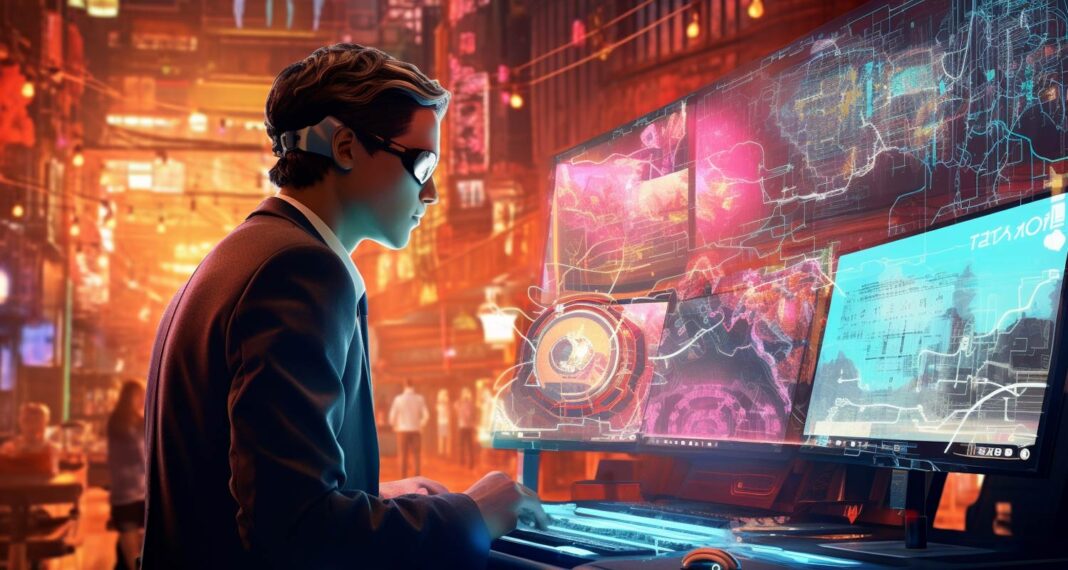
For decades, “gaming AI” was a misnomer. It usually referred to complex scripts and decision trees designed to make an enemy guard patrol a set path, or a racing opponent know when to take a corner. If you stood in a specific spot, you could break their programming, watching them fruitlessly run into a wall. It was artificial, but hardly intelligent.
Today, that is rapidly changing. The explosion of generative artificial intelligence and advanced machine learning is not just incrementally improving video games; it is fundamentally altering how they are built, played, and experienced. From hyper-realistic characters to endless worlds created on the fly, we are entering an era where games are no longer static experiences, but dynamic, evolving ecosystems.
Here is how AI is revolutionizing the gaming industry.
1. The Death of the Dialogue Tree: Next-Gen NPCs
Perhaps the most immediately noticeable change for players is the evolution of Non-Playable Characters (NPCs). Historically, interacting with an NPC meant selecting from a pre-written list of three or four dialogue options. Once you exhausted the list, the character became a broken record.
The integration of Large Language Models (LLMs)—similar to the technology powering ChatGPT—is breaking these boundaries. Developers are now experimenting with NPCs that can generate dialogue dynamically based on the player’s actions, reputation within the game world, and previous conversations.
Imagine an RPG where a shopkeeper remembers you stole an apple three towns over and refuses to trade with you, not because a programmer flipped a “stolen_apple” switch, but because the game’s AI model “understands” your reputation. We are moving toward worlds where every character has a unique personality and can engage in unscripted, natural conversations, making game worlds feel profoundly alive.
2. Procedural Generation on Steroids
Procedural Content Generation (PCG) isn’t new; games like Minecraft and No Man’s Sky have used algorithms to create vast, random terrains for years. However, traditional PCG often relies on mathematical noise functions, which can sometimes result in landscapes that feel repetitive or nonsensical.
AI-driven generation is changing this. Instead of just following mathematical rules, AI models trained on vast datasets of real-world geography, architecture, and artistic styles can generate environments that make sense.
AI can now be used to instantly generate realistic textures for 3D models, compose dynamic background music that reacts to the on-screen tension, and even design level layouts that are optimized for fun flow. This allows smaller studios to create massive, AAA-quality worlds without needing hundreds of artists working for years.
3. The Hyper-Personalized Experience
Until now, most games have offered a “one-size-fits-all” experience, perhaps adjusted by a simple Easy/Medium/Hard difficulty setting. AI is enabling true personalization.
Modern AI algorithms can analyze a player’s behavior in real-time. If the game detects you are struggling with a specific boss mechanic, it could subtly adjust the enemy’s aggression or provide slightly more health drops. Conversely, if you are breezing through, it could introduce new, unscripted challenges.
Beyond difficulty, AI can tailor content. If an open-world game recognizes you prefer stealth over combat, it might procedurally generate more infiltration missions in your quest log. The game becomes a director, curating the experience specifically for you.
4. Accelerating Development and Reducing Crunch
While players see the end results, the impact of AI behind the scenes is perhaps even more significant. Game development is notoriously expensive, time-consuming, and prone to “crunch” culture (long periods of mandatory overtime). Even browsing something simple like the cookout menu with prices takes far less effort compared to the complex process developers face when creating and refining modern games.
AI is becoming an essential partner in the development pipeline:
- Coding Assistants: AI tools help programmers write code faster, debug complex systems, and optimize game performance.
- Asset Creation: Tools like Midjourney or Stable Diffusion allow concept artists to rapidly iterate on ideas, while 3D AI tools can turn 2D images into textured 3D models in minutes rather than days.
- Quality Assurance (QA): Instead of humans playing the same level a thousand times to find bugs, AI agents can be trained to navigate games endlessly, trying to break the geometry and reporting glitches automatically.
By handling repetitive tasks, AI frees up human developers to focus on creative vision and high-level design.
5. Graphics and Performance Upscaling
AI is also doing the heavy lifting in rendering. Technologies like NVIDIA’s DLSS (Deep Learning Super Sampling) use AI to render a game at a lower resolution and then intelligently upscale it to higher resolutions like 4K.
This means gamers can get incredible visuals and high frame rates without needing the absolute most powerful graphics card hardware. AI is guessing what the pixels should look like, filling in the gaps to create smoother, sharper images, making high-fidelity gaming more accessible.
The “Uncanny Valley” and Ethical Challenges
Despite the excitement, the integration of AI in gaming is not without perils.
There are significant concerns about labor. As AI gets better at generating art, writing basic dialogue, and voice acting, fears rise that human creatives will be displaced. The industry is currently wrestling with the ethics of training AI models on copyrighted artistic works without permission.
Furthermore, there is the risk of the “uncanny valley”—where AI-generated characters or dialogue are almost realistic but slightly “off,” creating an unsettling experience. There is also a very real concern that over-reliance on AI generation could lead to a flood of soulless, generic content, where games feel vast but empty of human touch.
Conclusion
We are currently in the “wild west” phase of AI adoption in gaming. The technology is moving faster than the industry can fully standardize it. However, the trajectory is clear: AI is not merely a new feature; it is the new foundation.
The best games of the future will likely not be purely AI-generated. Instead, they will come from studios that master the symbiosis between human creativity and machine efficiency—using AI to handle the heavy lifting, the infinite generation, and the dynamic reactions, while human directors ensure the game retains its soul, intent, and artistic vision. Gaming is about to get a whole lot smarter.